

We Sit Shiva
An update on Isaac Mayer Wise (1880s) and my wife Anna M. B. (1981-2026)

Note: I can’t sleep, so I wrote this last night. This is the only way I know to distract myself right now.
The American Paradox
As a historian of American religion, I have long known the broad outlines of Isaac Mayer Wise’s story—and the story of a particularly American form of Judaism that he embodied. His is a story that captures what I call the “American Paradox”—my response to the idea of American exceptionalism.
In Wise’s story we see two truths embodied at once. Yes, the United States was founded as a Christian nation. Most of its founders were Christians. Christian assumptions shape to this day much of the nation’s moral vocabulary, political culture, institutions, and public life. And yes, the United States was also founded as an unprecedented experiment in religious and racial pluralism. The idea was to include Protestants of all denominations, Catholics, Jews, free Black communities, Indigenous peoples, Muslims, deists, skeptics, and countless others as full members of the American polity.
The story of American religion, I tell my students, is learning to hold these seemingly contradictory truths in mind at the same time. The framers—those directly involved like James Madison as well as figures like Phillis Wheatley and Samson Occom who influenced the culture from its edges—created a republic that was both deeply shaped by Christianity and remarkably open to religious diversity and experimentation. The American paradox is that both stories are true.
Isaac Mayer Wise’s life demonstrates what that paradox made possible. Born in Bohemia in 1819, Wise immigrated to a nation whose culture remained overwhelmingly Protestant, yet one whose institutions created space for religious minorities to flourish in ways unimaginable in much of Europe. Over the second half of the nineteenth century, he founded newspapers, schools, rabbinical associations, and congregations. More than perhaps any other religious leader of his era, he helped transform Judaism—a faith that is also a people—from a collection of scattered immigrant communities into a cohesive American religious tradition. In doing so, Wise did not merely adapt Judaism to America. He helped redefine what America itself could become.
For years, I taught this version of Wise in classes. I cited him in lectures about immigration, religious pluralism, and the making of modern America.
Then I began writing More, America.
For the last several weeks, despite falling behind as my wife Anna’s illness worsened, I have been trying to finish a chapter on Wise. My argument is that Wise was a founder of America writ large. To be sure, he helped create an American Judaism that matched his vision of a capacious, liberal, and forward-thinking nation. And through his very reform of Judaism he helped the nation in which such a Judaism could thrive. As such, like the other figures in the project, he expanded the boundaries of who counts as a founder of America.
At the start of this week, I promised myself I would finally finish the chapter and post it on Friday.
Instead, I found myself searching the internet to learn how to host a shiva.
Anna, my life partner of twenty-one years, died on Wednesday.
Jewish Doing, Not Being
Instead of polishing a draft about the institutions Wise built, I am suddenly depending on them.
The irony is hard to miss.
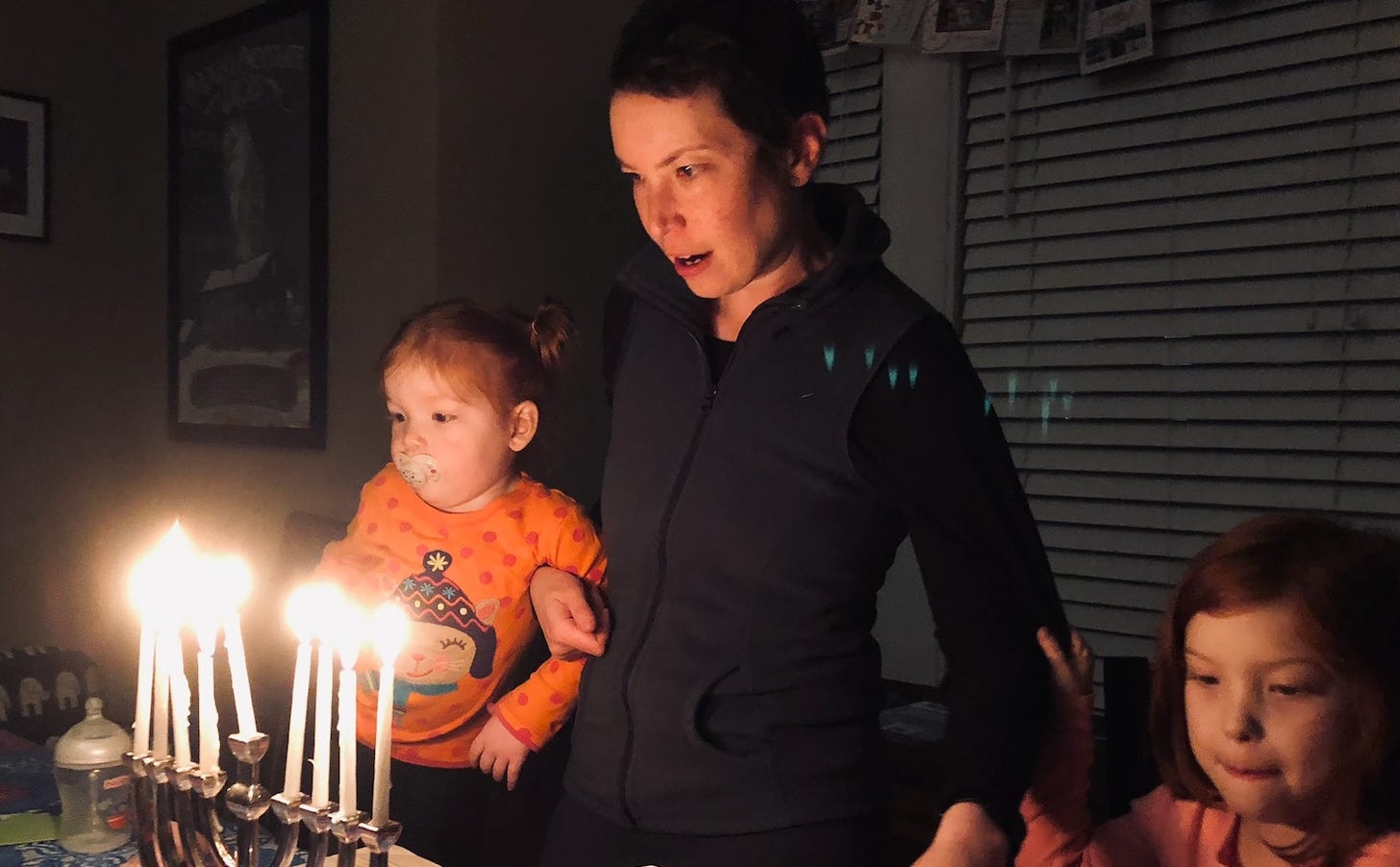
I am not Jewish. Throughout our marriage, Anna was the keeper of that tradition. Our Jewish family life was often modest: songs and menorahs at Hanukkah, family stories of escape—and not escape—from European fascism, and occasional visits to synagogue on the High Holy Days when life allowed. She did not send our daughters to Hebrew school as she herself had been sent growing up. And yet while Anna was not much of a joiner, she nevertheless inherited and carried a serious Jewish tradition.
That inheritance was itself a very American story. Her mother is Japanese American. Her maternal grandmother worked for years at a local Methodist church, and her maternal grandfather was an acclaimed photographer who worked in part for the Methodist missions. Anna’s father is culturally Jewish. Anna learned Judaism largely through him, neighbors—including rabbis of different Jewish stripes—and the predominantly Jewish communities of Long Island.
Again, what made Anna’s role in our own family even more interesting was that she was hardly conventionally religious. She was, at minimum, agnostic. She distrusted institutions. She had little patience for dogma.
And yet she was profoundly Jewish. Not in creed, but in ethos.
As a young woman, she went on Birthright. Rather than strengthening her attachment to Israel, the experience had the opposite effect. She returned troubled by what she saw as the militarized and ethnonationalist dimensions of the modern state. Long before October 7, she opposed the occupation of the West Bank and Gaza. She believed violence degraded everyone it touched. She believed Israel often exercised power in ways that contradicted the ethical obligations she associated with her Jewish inheritance.
Her criticisms of Israel did not emerge despite her Jewish identity. They emerged through it.
In the years since October 7, many have insisted that anti-Zionism and antisemitism are indistinguishable. Anna’s life offered a powerful rebuttal. Her objections to Israeli policy were not rooted in hostility toward Jews. They were rooted in what she understood Jewishness to require: the pursuit of justice, mercy, and human dignity.
As someone who works in Indigenous studies, I have often thought about how, in many ways, the Jewish story is different from the histories I study. Much of Native American history revolves around the defense of homelands, the recovery of land, and the exercise of sovereignty over territory. Jewish history, at least as Anna lived it, emphasized something else: a people held together across centuries of dispersion by memory, ritual, kinship, learning, and obligation. To be sure, the homeland matters deeply. L’Shana Haba’ah B’Yerushalayim—Next Year in Jerusalem—is one of the few Hebrew phrases I know, and I learned it from her. But it serves more as a wish for connection across space and time as much as a literal call to return.
Only now do I realize how much of that tradition Anna carried.
Because of distance within the family—and because the Holocaust destroyed the family trees that would have produced them—there is no obvious Bromberg elder to step forward and organize the rituals that follow death. Anna was that person. She knew the stories, or at least knew how to find the people who did. She knew the customs. She knew what came next.
So this Friday morning, instead of finishing my essay about Isaac Mayer Wise, I find myself reading practical guides to Jewish mourning. The guide I am relying on most, written by Rabbi Ana Bonnheim, comes directly out of one of the institutions—the Union of Reform Judaism—that Wise helped build.
Isaac Mayer Wise’s America in 2026
So there he is again.
For weeks I had been writing about the institutions he built. Now I am relying on them.
The irony deepens when I look at Lincoln’s Jewish community. We have occasionally attended services at one of the city’s two lovely but struggling synagogues. In Wise’s day, the divisions between Reform and Conservative Judaism could be fierce. Wise’s conservative critics feared that by embracing America’s promise of religious freedom and pluralism, he sacrificed the very traditions that had allowed the Jewish people to survive for millennia.
Today, however, Lincoln’s Reform and Conservative congregations have less reason to compete than to cooperate. The communities anchor opposite ends of our neighborhood, yet the distinctions that once divided them seem less important than survival, especially in an age of rising antisemitism and declining memberships.
As news of Anna’s death spread over the last few days, members from both congregations assembled a minyan required for the shiva. That minyan tonight will include Reform Jews and Conservative Jews. Men and women. Lifelong practitioners and people like me who stand outside the tradition but have nevertheless been embraced by it. Much of Lincoln’s Jewish community consists of a handful of interconnected families. In one particularly fitting example, one brother belongs to the Reform congregation and another to the Conservative.
I cannot help wondering what Wise would make of it all.
The institutions he built have changed in ways he could never have imagined. The communities are smaller. The boundaries are looser. The assumptions are different. Yet here, more than a century after his death, people are still gathering to do precisely what he believed American Judaism should do: sustain a community through life’s most difficult moments.
New Ironic Codes
Not all traditions, however, are communal.
On this same day, I will get my first tattoo.
It will be a single phrase: the pet name I had for Anna. I will keep the phrase to myself. Some things belong only to the two people who shared them. The tattoo will be rendered in Morse code. There is something fitting about that. A private message translated into a language of dots and dashes. A secret hidden in plain sight.
I confess there is another irony here. Samuel Morse, whose code I am borrowing, trafficked in some of the worst anti-Catholic and anti-immigrant conspiracies of the nineteenth century. Yet I find a certain satisfaction in using his invention to memorialize my agnostic Jewish wife. History has a way of refusing to cooperate with the intentions of its creators.
The irony would have made Anna laugh—and then roll her eyes.
She never would have forbidden it. We did not have that kind of marriage. But she certainly would have questioned it. Whenever tattoos came up, her skepticism was immediate and unmistakable. So I never got one.
Until now. This afternoon, before the service, my friend Kelsy Burke and I are going to get my first tattoo.
One of the strange discoveries of grief is realizing that the dead continue to shape your decisions even when they are no longer here to make them. This tattoo is not rebellion. It is remembrance. The shiva connects me to a tradition centuries old. The tattoo connects me to a single life. One is communal. The other is intensely personal. Both are attempts to answer the same impossible question: what do we do with all the love we still have for our beloved after our beloved is gone?
(Grieving in) More, America
In some ways, this is similar to the lesson I keep encountering in More, America. The founders who interest me are not trapped in the past. They created worlds that we still inhabit. What I have recognized this week is something else: their humanity. They, too, faced grief.
Phillis Wheatley Peters knew grief as a constant companion—from her forced separation from her family in West Africa to the death of her husband and children in adulthood. America’s first Black poet wrote not only about freedom and faith, but also about loss.
Wakara’s life was marked by the grief that accompanied war, disease, and colonial upheaval. Even as he built power and influence across the Great Basin, he lived in a settler-colonial world where loved ones could be killed with brutal violence and entire Indigenous communities could be wiped out by disease and death. He lost at least two wives to small pox, and likely several children.
Frances Ellen Watkins Harper was widowed while still a young mother, forcing her to raise her daughter alone. Rather than allowing grief to narrow her world, she transformed it into a deeper commitment to freedom, justice, and human dignity for all Americans.
Like me, Isaac Mayer Wise knew grief as a widower. When his wife Therese died in 1874 after thirty years of marriage, Wise was left to lead a large family while continuing the work of building American Judaism. The institutions he founded helped generations of Jews confront loss and mourning—including ours—shaped in part by his own experience of grief.
Anna carried the Jewish tradition in our family. Now that she is gone, I find myself depending on the institutions—and the rituals—that Wise helped build to carry us through these first days without her.
In a strange way, her death has not diminished her Jewish inheritance. It has revealed it. Tonight, our home will be full of Jewish visitors, Jewish rituals, Jewish prayers, and Jewish acts of care. The tradition she carried has become visible precisely because she is no longer here to carry it herself.
This Friday, the chapter on Isaac Mayer Wise remains unfinished.
Instead, we sit shiva.
So sorry to read this Max.
Thank you for showing us some of who Anna was, is, and always will be. And for your thoughtful ways of weaving your love for her into wisdom that also guides your thinking.